
The U.S. Constitution's 238th Birthday - and Noem v. Vasquez Perdomo
September 17th is Constitution Day in the U.S. It’s also called “Citizenship Day” and it is meant to celebrate the signing of the Constitution on September 17, 1787 and “recognize all who, by coming of age or by naturalization, have become citizens.” Happy Birthday!

(I thought Constitution Day was just picked out of a hat, but there’s actually a law that marks the day and invites the public to commemorate the day.)
The Constitution was created in response to the British government’s treatment of the colonies. Many of its provisions are direct reactions to the way power was being used against the colonies.
For example, the Fourth Amendment says,
The right of the people to be secure in their persons, houses, papers, and effects, against unreasonable searches and seizures, shall not be violated, and no Warrants shall issue, but upon probable cause, supported by Oath or affirmation, and particularly describing the place to be searched, and the persons or things to be seized.
But what does this mean? What has the Supreme Court said about this?
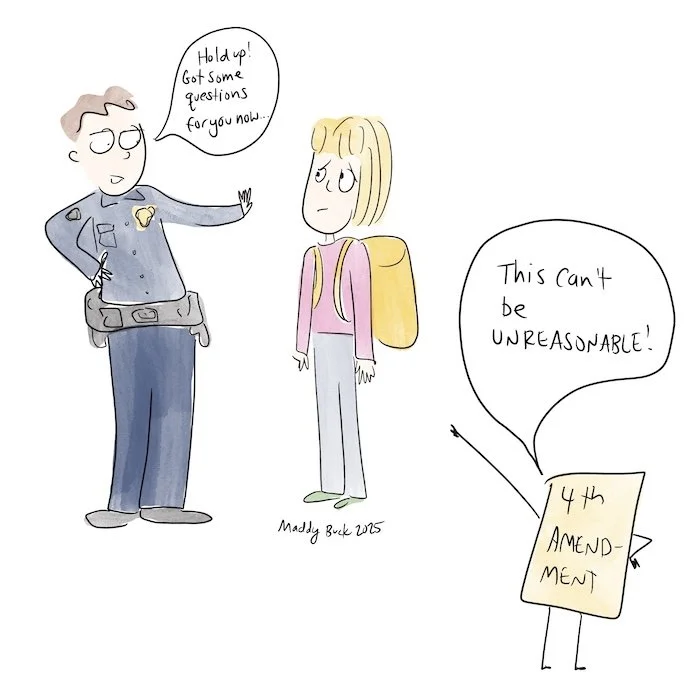
The Supreme Court has clarified that even when a police officer stops someone for questioning, that is a “seizure” that cannot be unreasonable, according to the 4th Amendment.1
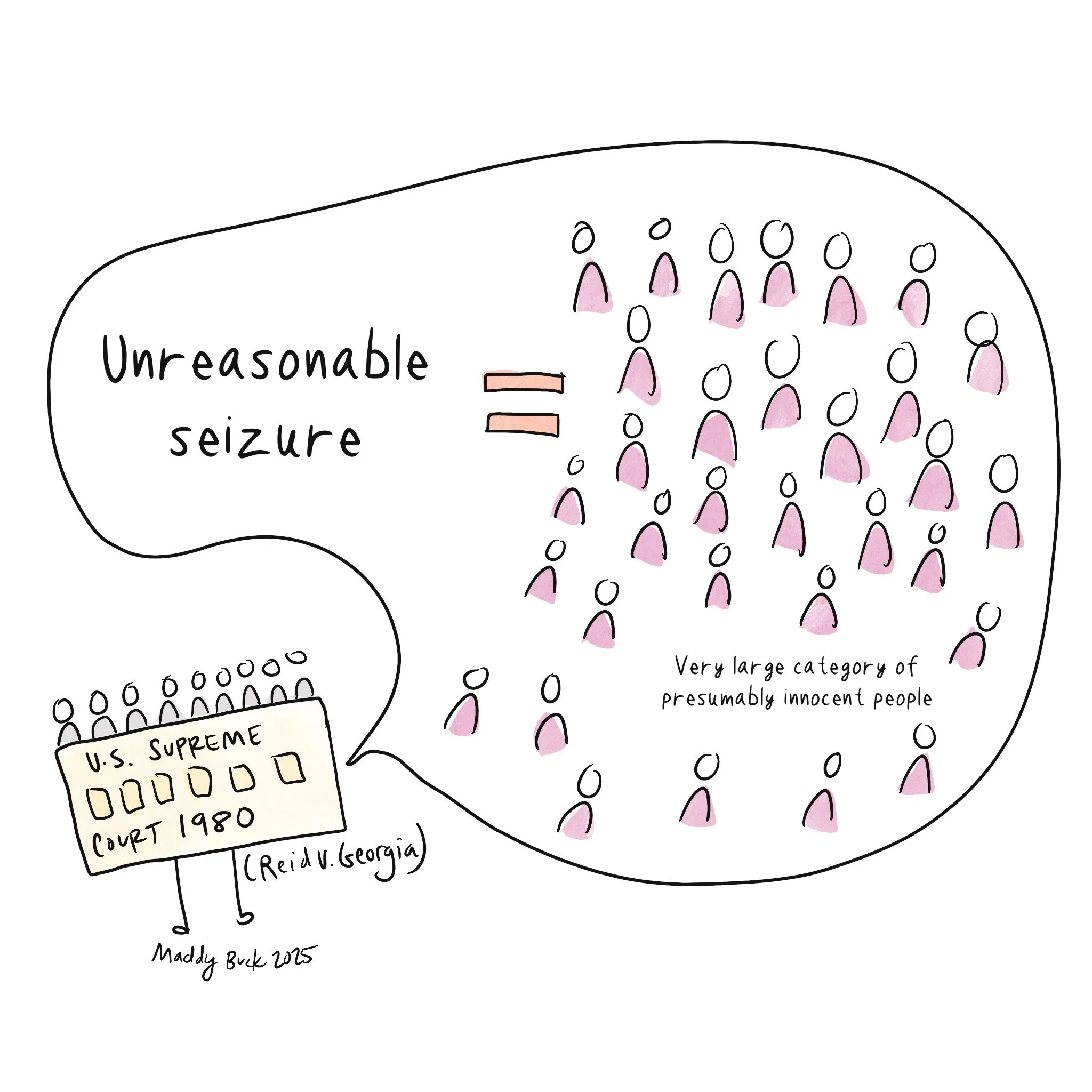
It has also pointed out that it’s “unreasonable” if a stop or seizure is based on a broad set of circumstances that “describe[s] a very large category of presumably innocent” people”.2
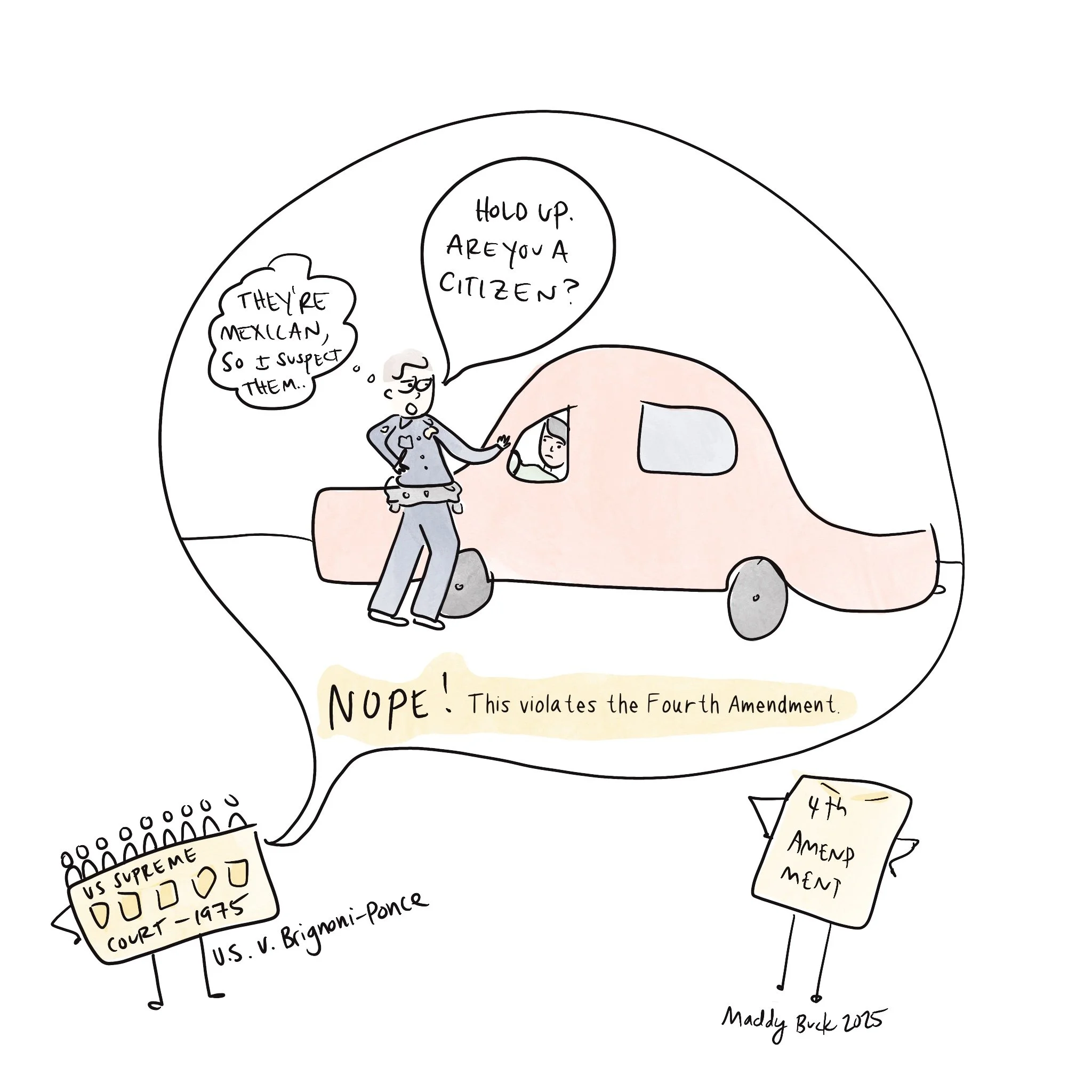
For example, the Court has decided in the past that border patrol agents violated the 4th Amendment when they stopped someone driving near the U.S.-Mexico border and asked them about their immigration status solely because they appeared to be of Mexican ancestry.3
Why is this relevant?
Earlier this year, a district court temporarily stopped ICE officials from detaining people in the L.A. area based solely on similarly broad factors:
1. being at particular locations like car washes, bus stops, day laborer pickup spots
2. doing a certain type of work
3. speaking Spanish or accented English
4. their “apparent race or ethnicity”

The District Court decided that this practice of detaining people for these broad reasons most likely violated the 4th Amendment, and that it was appropriate to put a quick stop to it (a temporary restraining order or preliminary injunction) while the litigation played out.
The Government asked the Supreme Court to intervene so it could continue this activity in its quest to detain undocumented immigrants while the underlying litigation plays out. The Supreme Court stayed (stopped, removed the injunction) the District Court’s decision.

As has been its practice lately for these “emergency” or “shadow docket” rulings, the Supreme Court didn’t provide any reasoning for its decision. Justice Kavanaugh wrote his own opinion (a “concurrence”) in support of the decision, and Justice Sotomayor wrote a dissent, joined by Justices Kagan and Jackson.

There were 3 writings - a concurrence, a dissent, and the main opinion.
What does this mean?
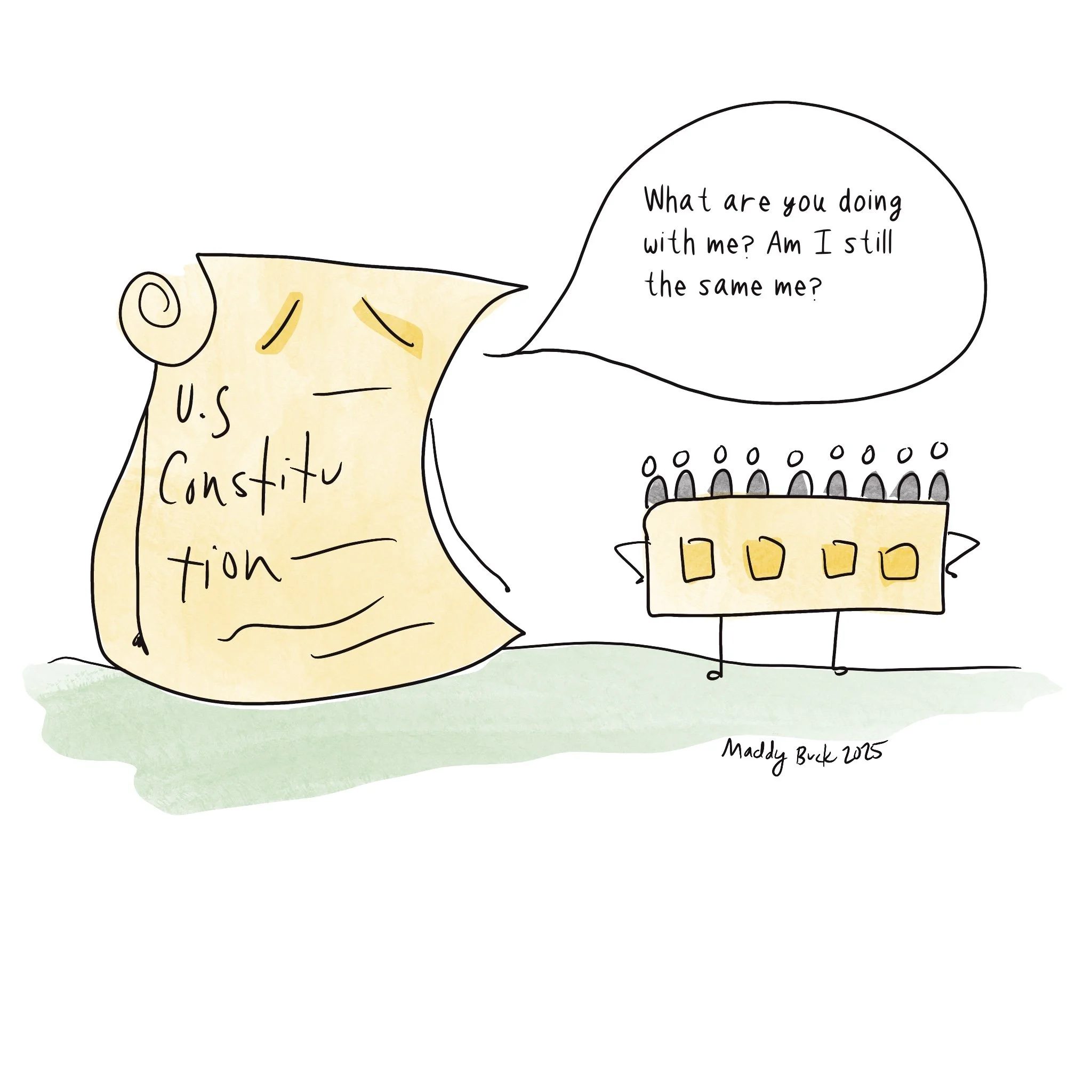
This means that the Supreme Court, with limited reasoning, is allowing
the government to continue detaining people based on these generalized criteria, which could, and has, included U.S. Citizens or others with legal immigration status. (Note that the Constitution applies to anyone in the U.S. regardless of citizenship.)
For example, here is the story of one of the U.S. citizens who brought this lawsuit, as described by Justice Sotomayor:
For instance, on June 9, immigration agents arrived at a tow yard in Montebello “carrying handguns” and “militarystyle rifle[s].” Jason Gavidia, a Latino U. S. citizen, was working on his car in the tow yard that day. A masked agent ordered Gavidia to “‘[s]top right there’” and began asking him questions. Agents then asked Gavidia whether he is “American at least three times”; three times, Gavidia affirmed that he is. Unsatisfied, the agents asked Gavidia for the name of the hospital in which he was born, and when Gavidia could not immediately recall, the agents racked a rifle, took Gavidia’s phone, “pushed [him] up against the metal gated fence, put [his] hands behind [his] back, and twisted [his] arm.” Id., at 6–7. Agents released Gavidia only after he offered up his REAL ID. That ID was never returned to him.
Does this change the 4th Amendment?
We don’t know for sure yet. This isn’t the final decision in the case because the Supreme Court’s opinion is meant simply to say “don’t stop the Government from doing this while the litigation is playing out.” But it represents a very different conclusion from what the Supreme Court has said in the past, where stopping someone based on their apparent “Mexican ancestry” violated the 4th Amendment.
As Justice Sotomayor says in her dissent,
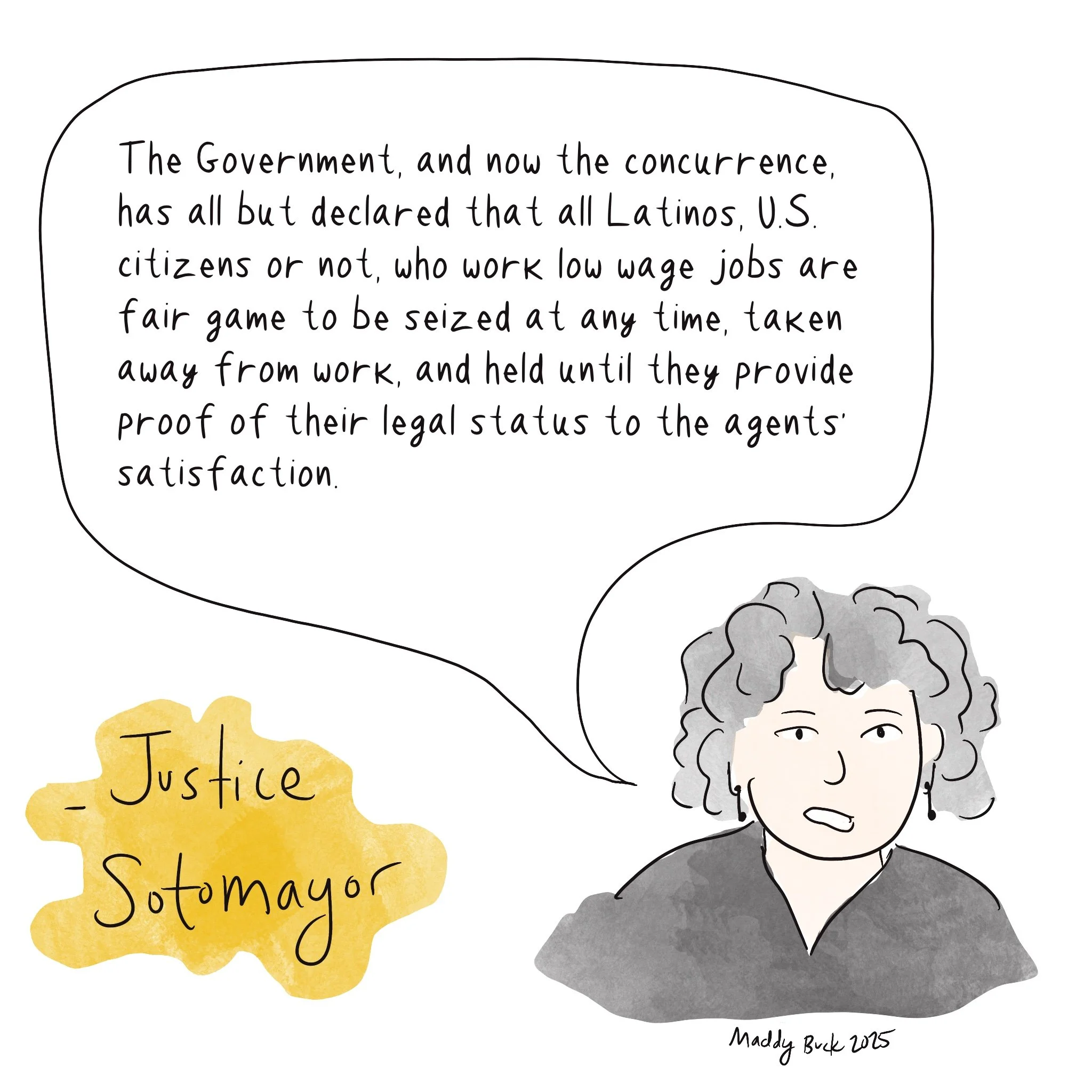
“The Government, and now the concurence, has all but declared that all Latinos, U. S. citizens or not, who work low wage jobs are fair game to be seized at any time, taken away from work, and held until they provide proof of their legal status to the agents’ satisfaction.”
If you read both available opinions (neither of which is the official opinion of a majority of the court), you see that one is based in the information already established in the case, and the other seems to be based on an ideal world scenario.

Justice Kavanaugh seems to think people are merely being asked a simple question and then being left alone when they quickly affirm they’re a citizen or in the U.S. legally.
“If the officers learn that the individual they stopped is a U. S. citizen or otherwise lawfully in the United States, they promptly let the individual go.”
But as Justice Sotomayor underlines, that’s not what the plaintiffs in the case have experienced and it puts the responsibility on anyone in these broad categories to be prepared to prove their citizenship at any moment. She writes,
Two plaintiffs in this very case tried to explain that they are U. S. citizens; one was then pushed against a fence with his arms twisted behind his back, and the other was taken away from his job to a warehouse for further questioning. More fundamentally, it is the Government’s burden to prove that it has reasonable suspicion to stop someone. The concurrence improperly shifts the burden onto an entire class of citizens to carry enough documentation to prove that they deserve to walk freely.
I’m glad for our Constitution and definitely celebrate its existence. But that celebration also comes with, for me, a recognition of the way recent Supreme Court decisions —even if they are technically “temporary”—are eroding our rights.
Interested in Supreme Court commentary? More legal commentary available here.
I’m a lawyer (Michigan Law alum) and artist, and I
simplify legal and technology concepts for lawyers, technologists, and academics with my human-made infographics.
run workshops for professionals that help build their creative brain muscles in a world of AI
provide analysis on the Supreme Court and rule of law using words and illustrations.
If you’d like me to run a workshop for your organization, translate your big idea, or break down the latest legal issues, I'd love to connect!