
This week, a federal district court in Massachusetts released a decision in American Association of University Professors v. Rubio concluding that the Trump administration had violated First Amendment rights when it arrested and attempted to deport students for their pro-Palestinian views.
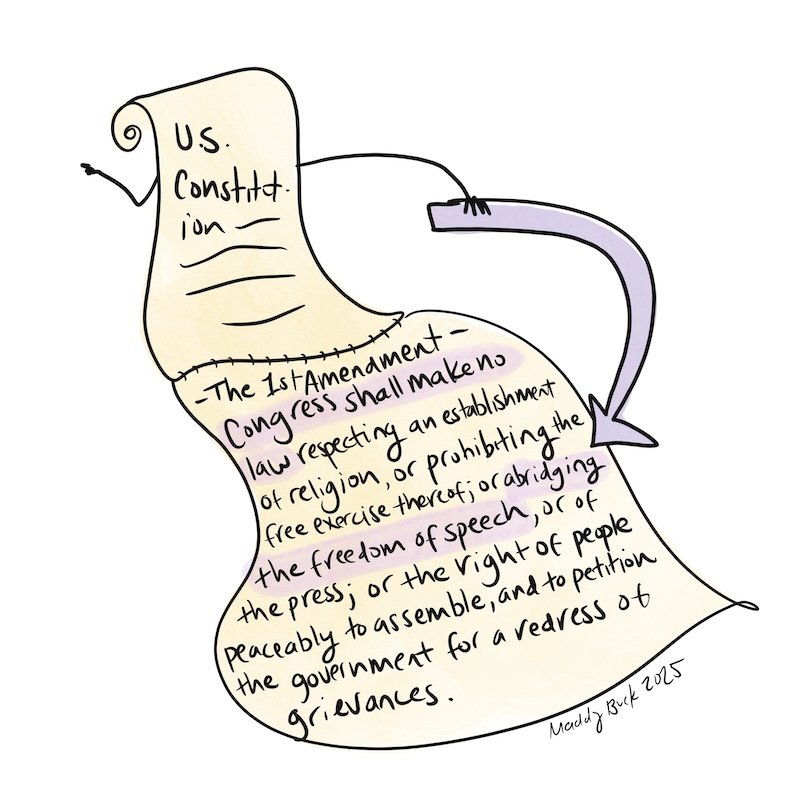
As a reminder, here’s what the First Amendment says, “Congress shall make no law…abridging the freedom of speech”
According to the decision, “[t]his case -– perhaps the most important ever to fall within the jurisdiction of this district court” is about “whether non-citizens lawfully present here in United States actually have the same free speech rights as the rest of us.”
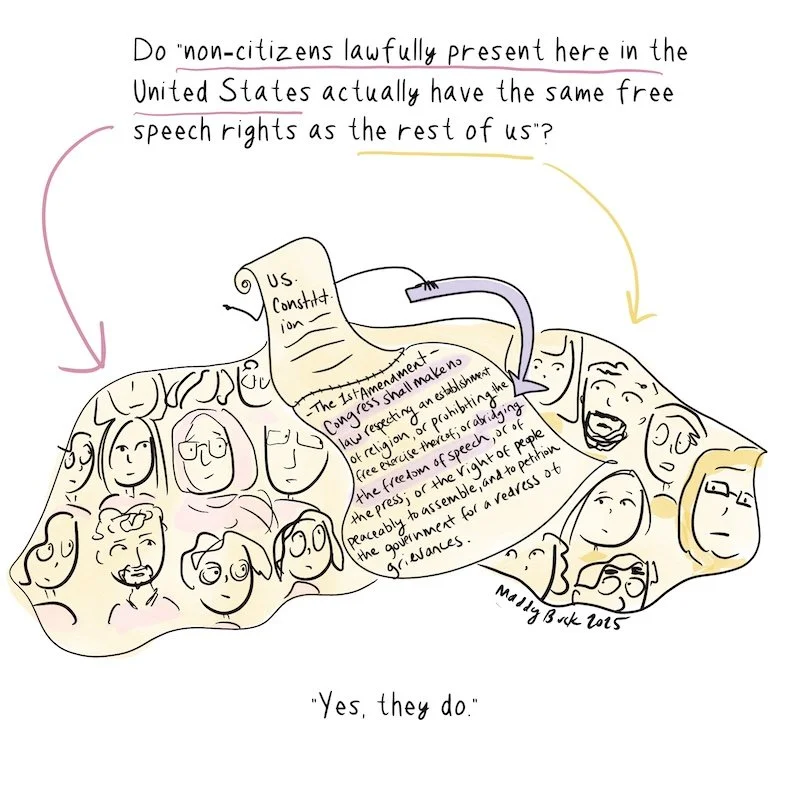
The conclusion, after a trial and a lot of legal analysis, is: “yes, they do.”
The decision is very long and will likely be widely critiqued. But it’s fascinating. First, for its structure.
The Entire Decision Is Also A Reply to An Anonymous Postcard
It starts with a scan of a postcard, an anonymous threat sent to this judge’s office in June 2025. Underneath the anonymous message is bold typewriter text that represents the judge’s reply to the anonymous writer.
The anonymous postcard threat says, “Trump has pardons and tanks…what do you have?” Judge Young replies, “Alone, I have nothing by my sense of duty. Together, We the People of the United States — you and me — have our magnificent Constitution. Here’s how that works out in a specific case —”
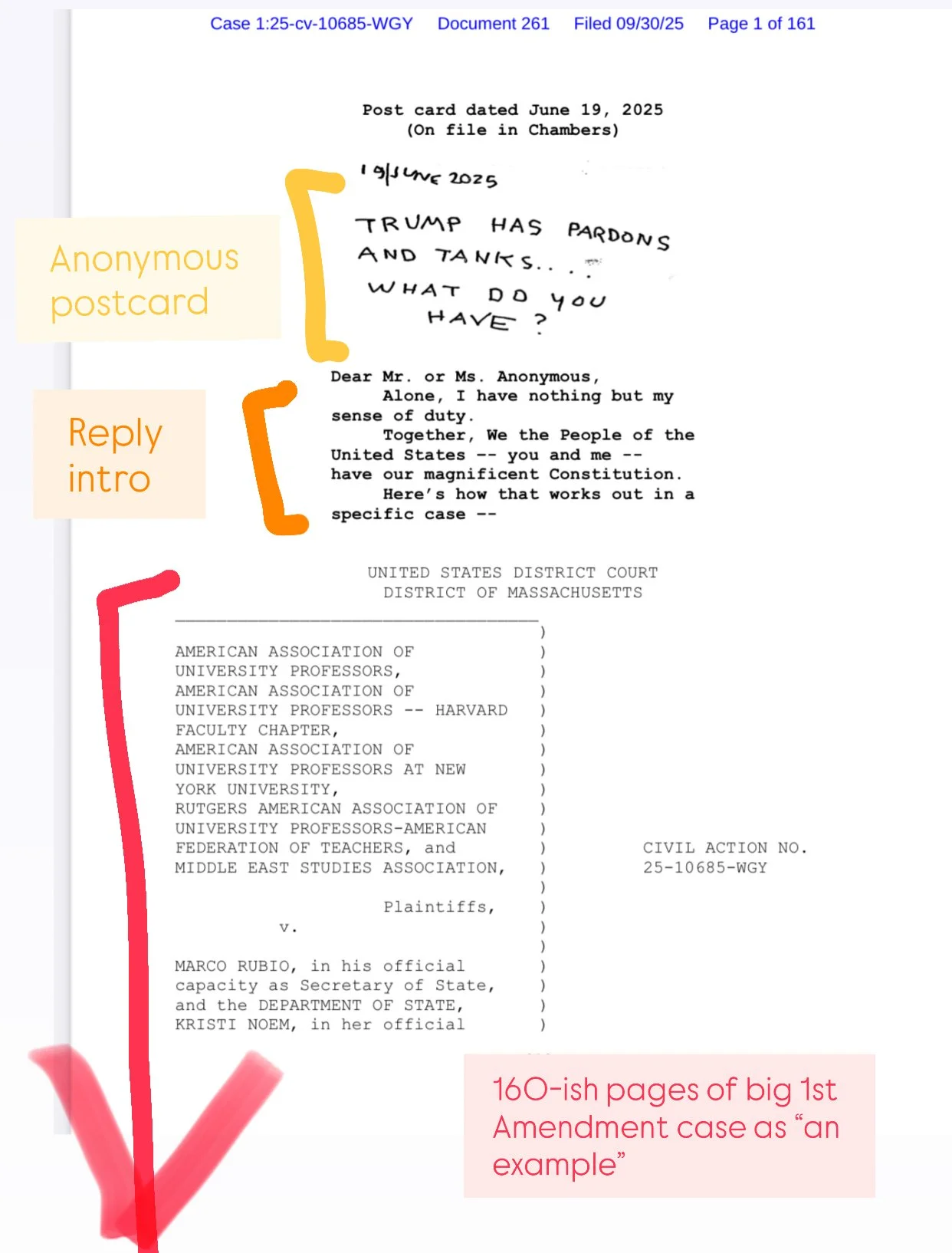
Next comes the decision, in the traditional format. The visual structure of this document makes it as if the decision is meant to be part of the “reply,” an example of what We, the People have in response to a president trying to exercise as much power as possible. We have “our magnificent Constitution” and its protections, including the right to free speech.
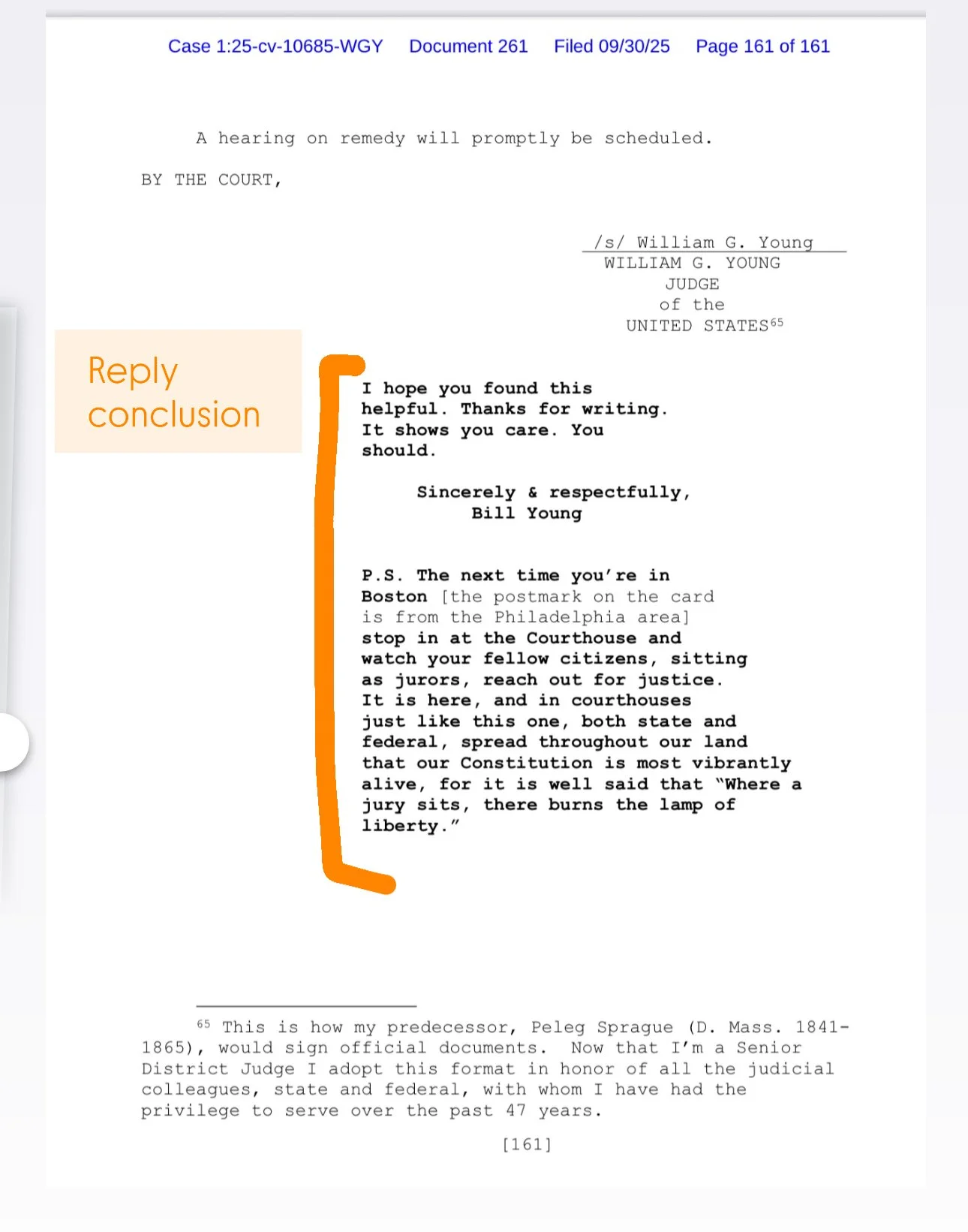
The document closes with more bolded text, the end of the judge’s “reply” to the anonymous postcard: “I hope you found this helpful. Thanks for writing. It shows you care. You should.” Ultimately, it’s framed as a “thank you” for caring about our government. The judge has chosen not to see the postcard as a threat, but a question.
This judge wrapped what he considers the most consequential decision to hit his courtroom inside a “reply” to the person who questioned anyone’s ability to do anything in response to the current president’s flexing of power.
As someone who loves using visuals to accentuate a message, I found this compelling. But in the very traditional world of the judicial system, I’m guessing it’s going to ruffle some feathers.
The Decision Explains That the Current President’s Relationship to the Law Makes It Hard to Right Constitutional Wrongs
The second fascinating part of this decision is the way that it points out, while analyzing the necessary next steps for this case, how hard it is to uphold constitutional rights in this moment. After determining the Administration violated the First Amendment, the decision emphasizes the need to determine a “remedy,” a fix for the harms of this violation of the First Amendment.
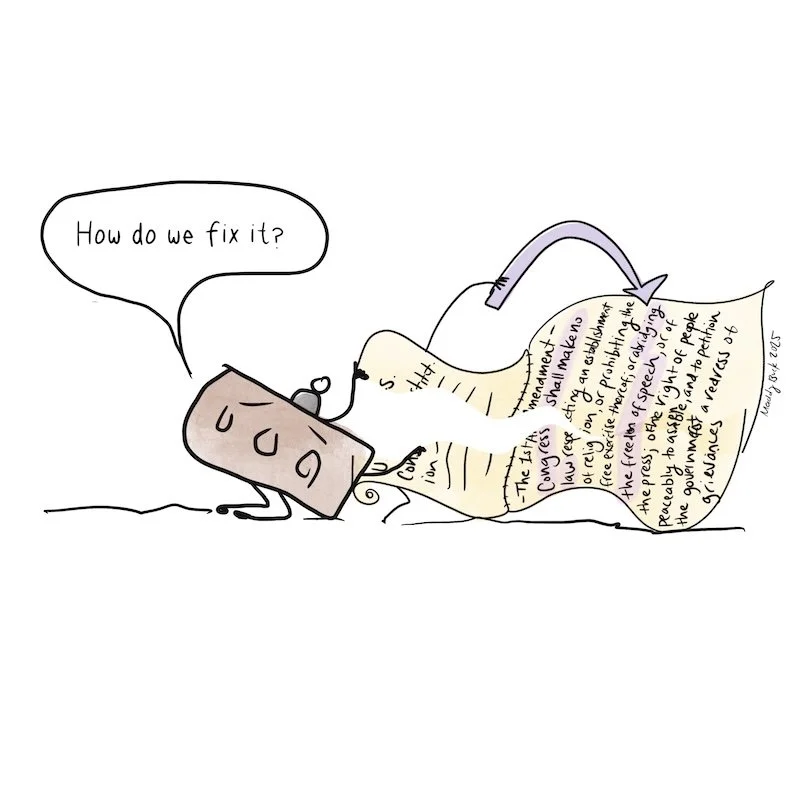
But what? It’s not obvious precisely because of how this president treats the First Amendment, understands and uses the limits of the legal system (its slowness, its cost, its retroactive nature), bullies opponents, and has successfully caused large institutions to settle instead of pursue their claims.
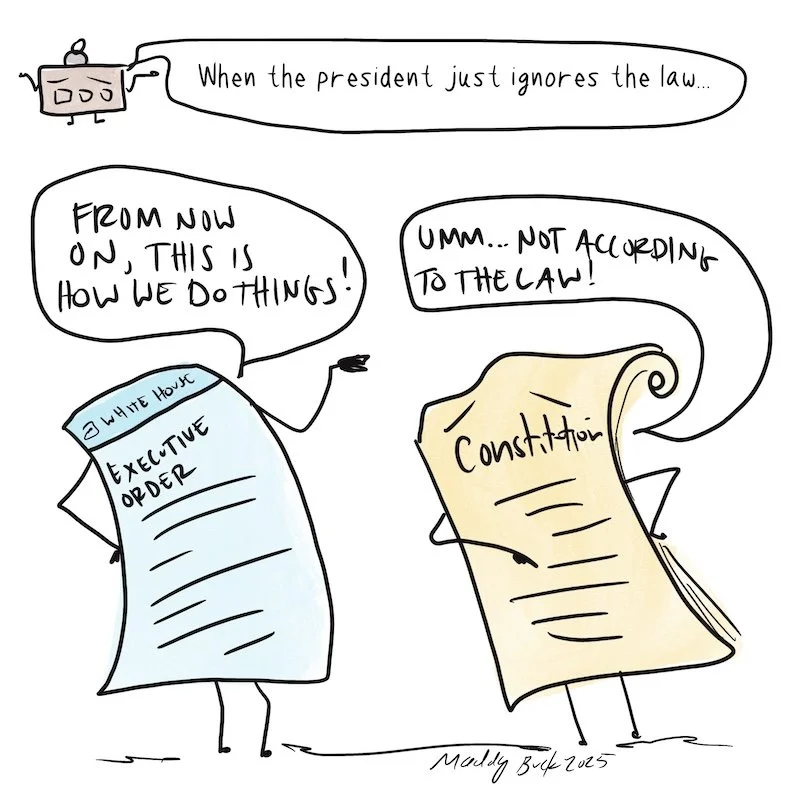
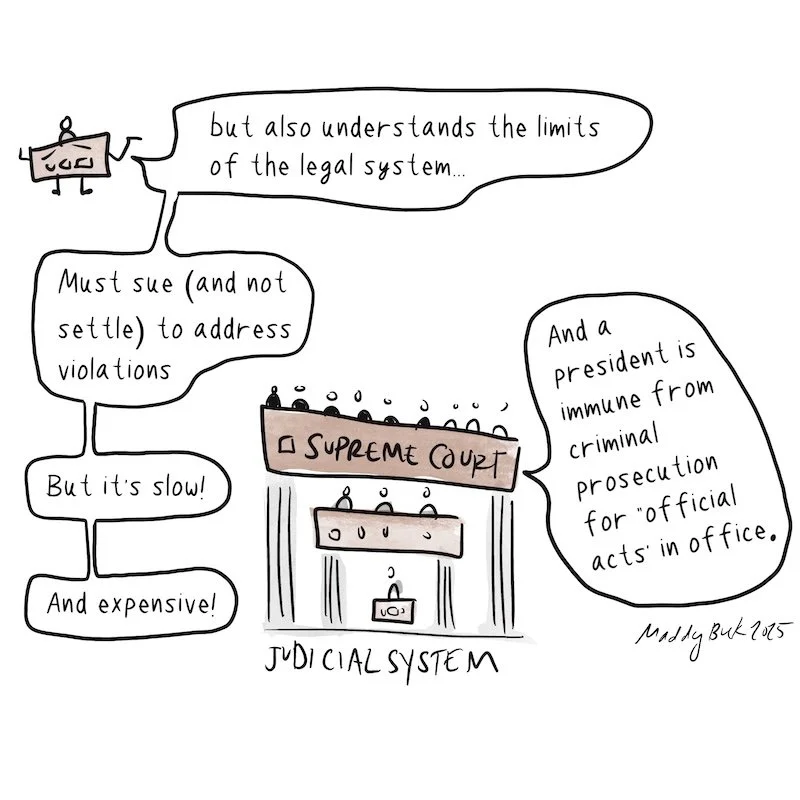
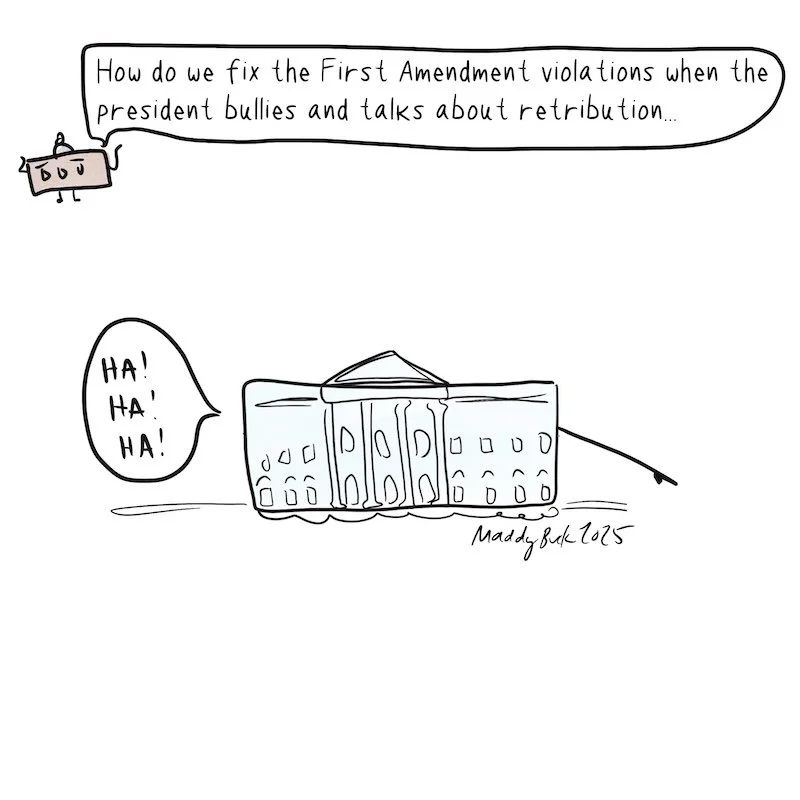
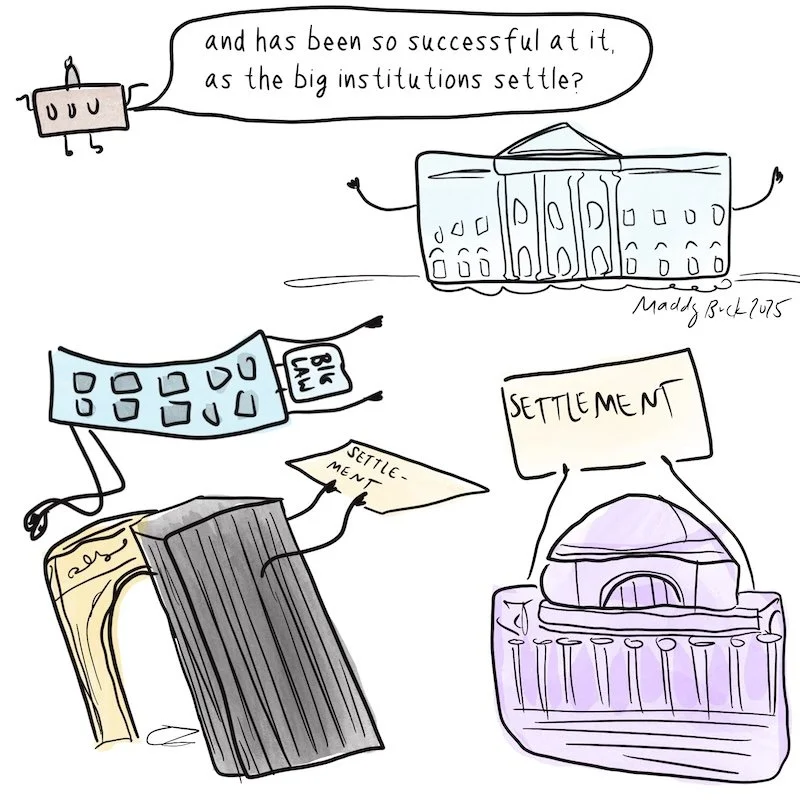
The decision notes that it’s not enough to just say “you can’t do this anymore.” Some other remedy is needed, and it can’t be limiting the president’s speech, limiting the speech of government officials, or limiting the Government’s ability to enforce the law.
So that’s what they’ll have to figure out at the next hearing.
The Decision Seems to be Speaking to Everyone—And Perhaps for History
There are so many quotable parts of this decision that I had to resist plopping them all in here. There is a whole section on the use of masks when detaining people. And a few questions about whether anything will change even after this decision goes out.
But I’ll just stick to the ending
The decision quotes President Reagan:
Freedom is a fragile thing and it’s never more than one generation away from extinction. It is not ours by way of inheritance; it must be fought for and defended constantly by each generation, for it comes only once to a people.
to make an observation about how, in the last six months, private interests (law firms, higher education, media) keep settling instead of standing up for the collective interest of We, the People to protect our rights under the Constitution.
If you take the anonymous postcard as a question and consider this document as a whole, the message seems to be that there is a way to respond to violations of the Constitution using the law—it’s not all hopeless. But this would be more likely if we, and in particular the most powerful institutions, choose to focus on the collective interests of We, the People.
Thank you for being here!
I’m a lawyer (Michigan Law alum) and artist, and I
simplify legal and technology concepts for lawyers, technologists, and academics with my human-made infographics.
run workshops for professionals that help build their creative brain muscles in a world of AI
provide analysis on the Supreme Court and rule of law using words and illustrations.
If you’d like me to run a workshop for your organization, translate your big idea, or break down the latest legal issues, I'd love to connect!
If you appreciated this piece, you may enjoy, VHS Tapes and How SCOTUS Decides What a Law Means